Posted bare-rooted on Mondays · Australia-wide except WA, TAS and NT · Get release alerts

Key points
- Clivias like bright shade: gentle morning sun is fine, hot afternoon sun burns the leaves.
- Free drainage matters most. Too much water kills far more clivias than too little.
- Most garden clivias are Clivia miniata, which flowers from late winter into spring in Australia.
- Clivias are frost-tender, so protect them under trees, eaves or frost cloth.
- All parts are toxic if eaten, so keep plants and berries away from pets and small children.
What is a clivia?
Clivias are evergreen, clump-forming perennials with glossy, strap-shaped leaves and big heads of trumpet-shaped flowers. They grow from a short, fleshy underground stem rather than a true bulb, and their thick roots store water, which is why an established plant can ride out a dry spell.
Despite common names like bush lily and Natal lily, clivias aren’t true lilies. They belong to the amaryllis family (Amaryllidaceae), alongside crinums and hippeastrums. The genus is named after Lady Charlotte Clive, Duchess of Northumberland, an early grower of clivias in England.
Where clivias come from
All clivias are native to southern Africa. Most grow in the forests of South Africa’s Eastern Cape, KwaZulu-Natal and Mpumalanga, and in Eswatini, in dappled shade, often in large colonies, in well-drained soil full of leaf litter. Copy those conditions and you’re most of the way there.
Six species are recognised: Clivia miniata, C. gardenii, C. nobilis, C. caulescens, C. robusta and C. mirabilis. The last was only formally described in 2002, from a dry, winter-rainfall area of the Northern Cape.
Which clivia do most people grow?
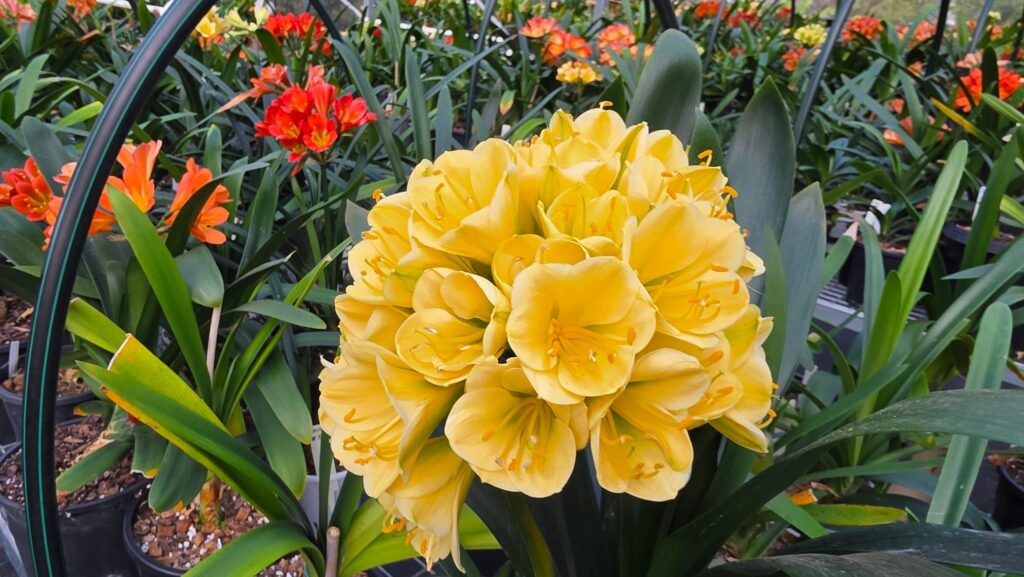
Most clivias in Australian gardens are Clivia miniata. It carries rounded heads of open, upward-facing trumpets, classically orange and now bred in yellow, cream, peach, red and many shades in between. The other five species have narrower, hanging, tubular flowers, and C. gardenii and C. robusta flower in autumn and winter, roughly April to July, rather than spring. Breeders also cross species to create interspecific hybrids.
At Valewood we grow all six species in our shade house. The care advice here is written for C. miniata, the one most people start with. For more on flower colours, see colours and breeding.
How we grow ours
Our plants grow north of Toowoomba in a shade house under 80% black shade cloth, on waist-height benches so air moves freely around them. Winters here can drop to -7.5°C, so we cover plants with frost cloth on extreme nights.
Light and shade
Clivias are shade plants. Gentle morning sun is fine, but hot midday and afternoon sun bleaches and scorches the leaves. Good spots include under trees, along a shady fence, on an east- or south-facing verandah, or in a shade house under about 70 to 80% shade cloth.
Too much shade brings its own problems: plants stretch, grow leggy and flower poorly. Aim for bright, dappled shade.
Frost and heat
Clivias are frost-tender, and frost damages the leaves. In frost-prone areas, plant them under a tree canopy or eaves, grow them in a shade house, or keep frost cloth ready for cold nights. Potted plants can be moved somewhere sheltered for winter.
Summer heat is less of a problem than hot sun and warm, wet roots together. Keep plants shaded, give them plenty of airflow, and take care with watering on very hot days.
Pots or garden beds?
Clivias grow well in both. In the garden, choose loose, free-draining soil with plenty of organic matter. Avoid heavy clay: build up a raised bed or plant on a slight slope instead. Plant high, with the base of the leaves sitting just above the soil, and mulch with leaf litter or well-rotted compost.
Pots suit cold areas because you can move them to shelter, and they make watering and pest checks easier. Clivias flower well with slightly crowded roots, so choose a pot only a little bigger than the root ball, and stand it on feet or a bench so it drains freely and air moves underneath.
The finger test
Not sure whether to water? Push a finger 5 to 10 cm into the mix. If it’s damp, wait. If it’s dry, water thoroughly, in the morning.
Potting mix
Drainage matters most. When you water a pot, the water should run straight out of the bottom. Use a coarse, open mix based on composted pine bark, such as a good orchid or bark mix blended with some premium potting mix. Don’t use garden soil or garden compost in pots: they hold too much water and invite root rot. There are more mix ideas in potting, repotting and dividing.
Watering
Established clivias are drought-hardy and far more likely to die from too much water than too little. As a rough guide, mature potted plants need a thorough soak about once a week from spring to autumn, and only once or twice a month in winter. Before you water, push a finger 5 to 10 cm into the mix. If it’s still damp, wait.
Water at the base rather than into the centre of the plant. At Valewood we never water in the evening or when rain is forecast, we don’t water when it’s over 30°C, and we water sparingly while plants are dormant in winter. These habits help prevent rot.
Feeding
Clivias respond well to regular feeding, especially in bark-based mixes that hold few nutrients. A slow-release fertiliser with trace elements is the easiest option. Go easy on nitrogen: too much can stop a plant flowering.
At Valewood we use a quality 9-month slow-release fertiliser with trace elements during the growing season, and again in mid-winter to support flower development.
When do clivias flower?
In Australia, Clivia miniata flowers from late winter to spring, mainly August to October and sometimes into November, with the odd flower at other times of year. In cool inland areas like Toowoomba, plants are usually at their best in September, when the Toowoomba Clivia Society holds its annual show during the Carnival of Flowers. Each flower head lasts for weeks.
Good flowering depends on a cool winter, enough light and a well-fed plant. If yours won’t bloom, see why won’t my clivia flower?
Mind the berries
Clivia berries are among the most toxic parts of the plant. If small children or plant-chewing pets share your garden, remove the berries or grow plants out of reach.
How long do clivias live?
A long time. Clivias are slow-growing and long-lived, and a well-kept plant can keep growing and flowering for decades, slowly building into a large clump. Seedlings of C. miniata usually take 4 to 5 years to flower (sometimes 3 in ideal conditions), and some other species take longer.
Are clivias poisonous?
Yes. All parts contain lycorine and related alkaloids, and the base of the plant and the berries are the most toxic. Eating them can cause vomiting, drooling and diarrhoea, and large amounts can cause more serious effects in pets. Clivias don’t cause the kidney failure in cats that true lilies and daylilies can, but they are still toxic to cats and dogs. The sap can irritate skin, so wear gloves when dividing or repotting.
If a person has eaten part of a clivia, call the Poisons Information Centre on 13 11 26 (24 hours, anywhere in Australia). If a pet has, call your vet.
Quick-start checklist
- Pick a spot in bright shade, with morning sun at most.
- Use a coarse, free-draining potting mix, or improve the garden bed so it drains well.
- Choose a pot only slightly larger than the roots, and raise it off the ground.
- Water thoroughly, then wait until the mix is drying before watering again. Water in the morning.
- Feed with a slow-release fertiliser with trace elements, and avoid high-nitrogen feeds.
- Protect plants from frost in winter and from hot sun in summer.
- Check leaf bases for mealybug and caterpillars, and look for snails after rain.
- Keep plants and berries away from pets and small children.
Common questions
Is a clivia a type of lily?
No. Clivias belong to the amaryllis family, not the true lily family, even though common names like bush lily suggest otherwise. They are still toxic to pets, but they don’t cause the kidney failure in cats linked to true lilies.
How big does a clivia grow?
A mature Clivia miniata clump can reach about 60 cm tall and almost as wide, and it slowly spreads as offsets form around the base.
Sources and further reading (22)
- SANBI PlantZAfrica: Clivia miniata
- SANBI PlantZAfrica: Clivia mirabilis
- SANBI PlantZAfrica: Clivia robusta
- Melbourne Clivia Group: Clivia species
- Botany Brisbane: Clivia
- Pacific Bulb Society wiki: Clivia
- Melbourne Clivia Group: Cultivation of Clivias, Clivia Pests and Diseases (cultivation notes PDF)
- Burke's Backyard: Clivia in Deep Shade
- Garden Clinic: How to cultivate clivias
- Garden Clinic: Clivia
- Royal Horticultural Society: How to grow clivias
- University of Wisconsin Extension: Clivia
- Pacific Horticulture: Cultivating Clivia
- Chicago Botanic Garden: Clivia nobilis
- White Flower Farm: Break-Through Clivia Bred by Longwood Gardens
- Toowoomba Clivia Society: Clivia Show
- ASPCA Animal Poison Control: Clivia Lily
- Pet Poison Helpline: Clivia miniata (listed under an outdated common name)
- Melbourne Clivia Group: Is my Clivia poisonous to pets?
- NC State Extension Plant Toolbox: Clivia miniata
- RSPCA Knowledgebase: What garden dangers must I protect my pet from?
- Queensland Poisons Information Centre: Poisons helpline 13 11 26
Grow guide
Keep learning
Month-by-month jobs for a frost-prone garden.
The usual reasons, with a quick flowering check.
Group 1 and 2 yellows, cross names and hand-pollinating.
Pots, mixes, dividing offsets and bare-root arrivals.
From ripe berry to first leaf, the Valewood way.
Mealybug, lily caterpillar, rots and leaf marks.
Quick answers to the questions we hear most.
Umbels, tepals, splits and selfs explained.
Release alerts
Be first to know about the next release
Plants are released in small batches, mostly in flowering season, and the best go quickly. Join the release list and we’ll email you when new plants go live.
Get Valewood Clivias news and alerts when new plants are released, for the interests you choose. We’ll send you an email to confirm your sign-up first, and you can unsubscribe at any time. See our Privacy Policy. Prefer to choose what you hear about? Pick your interests.