Posted bare-rooted on Mondays · Australia-wide except WA, TAS and NT · Get release alerts

Key points
- Yellow comes in two main genetic groups: same group x same group gives yellow, Group 1 x Group 2 gives orange.
- Yellow and peach are recessive, so they can hide behind orange for a generation.
- From yellow parents, seedlings with plain green bases will flower yellow.
- Cross names list the seed parent first, then the pollen parent.
- Berries take about 9 to 12 months to ripen.
Where clivia colours come from
Clivia flowers get their colour from two kinds of pigment. Carotenoids give yellow and orange, and anthocyanins add red and pink. A wild Clivia miniata combines both, giving its familiar orange. A yellow clivia has the anthocyanin pathway blocked, so only the yellow carotenoids remain.
Yellow forms were first recorded in the wild near Eshowe in 1888 and were named C. miniata var. citrina in 1899.
The colour range
- Orange: the wild colour, from soft orange to deep orange-red, usually with a yellow throat.
- Red: deeper selections from orange. Even the best reds usually keep a touch of orange.
- Yellow: from pale lemon and cream to rich butter yellow, in two main genetic groups (see below).
- Peach and pastel: soft peach, apricot, pink and cream blends. Peach comes in several genetic groups that don’t all breed true when crossed with each other.
- Blush: yellow or cream with pink to red flushing towards the petal edges.
- Bronze: deep maroon-red to brownish shades.
- Green: lime, jade or creamy green flowers, plus green throats on yellows and oranges. True greens are rare.
- White and cream: near-white clivias exist, but a pure white is still very rare.
- Bicolour and picotee: a bicolour shows two distinct colours in one flower; a picotee is pale with a narrow, darker edge.
- Multipetal (multi-tepal): more than the usual six tepals. Many are unstable, mixing 6, 8 and 12-tepal flowers in one head; stable forms take generations to build.
Keep a cross book
Number every cross and record the seed parent, pollen parent, date and result.
Leaf forms and variegation
Broad-leaf forms. Japanese and Chinese breeders have spent decades turning C. miniata into a foliage plant with short, wide, thick, often heavily veined leaves. The compact Japanese strain is called Daruma, after the round Daruma doll. Chinese breeders prize glossy, smooth, stiff, thick leaves held in one flat fan.
Variegates. These have cream, yellow or white stripes or patches in the leaves. Striata (lengthwise stripes) is by far the most common type; others include fukurin (pale margins), akebono (pale, misty bands) and tiger (crosswise bands).
Most variegation passes only through the seed parent (tiger is the known exception), so breeders use the variegate as the mother. Expect a mix of green, variegated and white albino seedlings; albinos die once the seed’s food runs out. Pale leaf areas burn easily, so give variegates good light but no hot sun.
Group 1 and Group 2 yellows
Yellow clivias fall into two main genetic groups. Both are recessive, so a plant needs two copies of the same yellow gene to flower yellow, and because the groups are different mutations:
- Group 1 x Group 1: yellow seedlings that breed true.
- Group 2 x Group 2: usually yellow seedlings.
- Group 1 x Group 2: usually all orange seedlings, sometimes in softer shades.
- Any yellow x an unrelated orange: orange seedlings, each carrying the yellow gene hidden (“split for yellow”).
Well-known Group 1 yellows include ‘Vico Yellow’, ‘Kirstenbosch Yellow’ and ‘Mare’s Yellow’. ‘Natal Yellow’, ‘Dwesa Yellow’ and ‘Kentani Yellow’ are classed as Group 2. Breeders also describe a Group 3 and smaller groups; that classification is still settling.
How to tell them apart
Usually you can’t by eye. Group 1 yellows show no trace of red pigment in their flowers or berries. Some Group 2 yellows show faint pink streaks or flecks, especially where bruised or rain-spotted, but many look just like Group 1.
Seedling base colour won’t separate the groups either, because a same-group cross gives plain green bases in both. The reliable answer is a test cross with a yellow of known group: green-based seedlings mean your plant shares that group, reddish maroon bases mean it doesn’t.
Cross check
Choose the two parents to see what their seedlings are likely to look like. Genetics in clivias isn't always tidy, so treat this as a guide, not a promise.
"Split" means an orange plant known to carry one hidden copy of a yellow gene, usually because one parent was yellow.
Open-pollinated seed is a lottery
For predictable colours, hand-pollinate and cover the stigma rather than relying on natural pollination.
Reading a cross name
A cross is written seed parent first: “Plant A x Plant B” means Plant A carried the berries and Plant B supplied the pollen. You will also see:
- x self: a flower pollinated with pollen from the same plant or one of its offsets.
- Sib cross: two seedlings from the same cross, crossed together.
- OP (open pollinated): seed set naturally, with an unknown pollen parent. OP seed from a yellow usually gives very few yellows.
- F1 and F2: the F1 is the first generation from crossing two different plants. Crossing two F1 siblings, or selfing an F1, gives the F2.
- Split for yellow: an orange-flowered plant carrying one hidden copy of a yellow gene.
How to hand-pollinate a clivia
- Plan. Choose a healthy seed parent and pollen parent, and write the cross down first.
- Emasculate the seed parent. As soon as a flower opens, and before its anthers split and release pollen, pluck off all six anthers with clean tweezers. Anthers usually open on the day the flower opens or the next, so check early.
- Collect pollen. Take ripe, dusty anthers from the pollen parent. Dry pollen sealed in the freezer keeps for years, so you can cross plants that flower at different times.
- Wait for the stigma. It is ready when its three tips have opened out and look moist and slightly sticky, which can be a day or more after the flower opens. Check daily. Red or brown tips mean you have missed it.
- Apply the pollen. Dab it onto the stigma tips with a fine brush, cotton bud or the anther itself, ideally early in the morning. Repeat over the next day or two.
- Protect and label. Slip a short piece of drinking straw, sealed at the top, over the stigma to keep insects off. Tie a label with the cross and date to that flower’s own stalk (the pedicel).
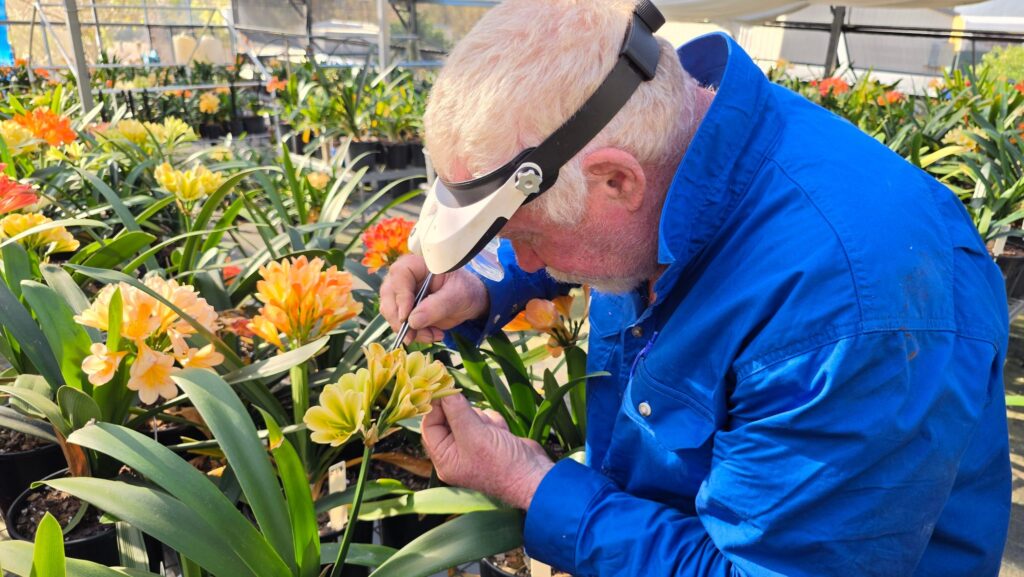
Berries and seed
Flowers that didn’t take usually drop within about a month. A successful berry ripens over about 9 to 12 months, turning from green to red, or to yellow on many yellow-flowered plants (C. mirabilis is quicker, at about four to five months). Then turn to Raising clivias from seed.
How we name our crosses
Valewood cross names follow the standard order, seed parent x pollen parent, so the first name is the plant that carried the berries.
What to expect from seedlings
Every seedling is a new mix of its parents’ genes, so a batch can vary in colour, flower shape and leaf. For an exact copy of a plant you need an offset, not seed.
Yellow crosses give an early clue. At the base of the first or second leaf, plain green means yellow flowers ahead and reddish maroon means orange. This works for Group 1 and Group 2 yellows, but not for Group 3 yellows or every pastel or blush line, as some have pigmented bases at germination. Most C. miniata seedlings flower in 4 to 5 years.
Interspecific hybrids
Interspecifics are crosses between two clivia species, usually C. miniata with one of the pendulous species. They bring semi-pendulous or flared flowers, green tips and new colour blends, and many flower in winter.
The oldest is Clivia × cyrtanthiflora (C. nobilis crossed with C. miniata), raised in Europe in the 1800s. Clivia × nimbicola, a natural hybrid of C. miniata and C. caulescens, was described in 2006.
Recessive traits often wait until the second generation. A yellow C. miniata crossed with C. nobilis gives orange F1 plants, and crossing those F1s together can then give around a quarter yellow.
Common questions
Will seed from my yellow clivia come up yellow?
Only if it was pollinated by a yellow of the same group. A selfed Group 1 yellow usually comes true, but a selfed Group 2 yellow often gives mostly orange seedlings. Open-pollinated seed from a yellow usually gives mostly orange seedlings.
Why did my yellow x yellow cross give orange seedlings?
The parents were almost certainly from different yellow groups. Those seedlings carry both yellow genes, so they are still useful for breeding.
Sources and further reading (36)
- SANBI PlantZAfrica: Clivia miniata var. citrina (G. Duncan, 2017)
- Shields Gardens: Yellow clivia
- Shields Gardens: Clivia yellows
- Shields Gardens: Peach and pink clivia
- Pacific Bulb Society list: J.E. Shields on clivia colour genetics (2010)
- Pacific Bulb Society list: J.E. Shields on recessive yellows and peaches (2010)
- Pacific Bulb Society list: yellow groups and seedling bases (2021)
- Pacific Bulb Society list: clivia breeding (2021)
- Wikipedia: Clivia
- Clivia Mart: Review of clivia groups and mutations (Saayman, Holt and Mann)
- Clivia SA: Clivia miniata colour mutations and their breeding
- Clivia USA: Yellow clivia groups
- Clivia USA: How to pollinate a clivia and store pollen
- Clivia USA: Breeding basics
- Utopia Clivias: Yellow clivias
- Utopia Clivias: Peach clivias
- Utopia Clivias: Green clivias
- Utopia Clivias: Clivia pollination
- Pine Mountain Nursery: Clivia flowering colours
- Pine Mountain Nursery: Euro peach genetics
- Pine Mountain Nursery: Variegated clivia
- Melbourne Clivia Group: Growing variegates (Helen Marriott)
- Melbourne Clivia Group: An introduction to interspecific hybrids (Helen Marriott)
- Melbourne Clivia Group: F1 and F2 terminology (Lisa Fox)
- Melbourne Clivia Group: Blush clivia (Di Mathews)
- San Marcos Growers: Clivia symposium notes (Japanese and Chinese clivias)
- Pacific Horticulture: Clivia
- Strange Wonderful Things: Clivia miniata Daruma form
- Best Clivias: Multipetal clivia
- Nick's Clivias: Multipetal clivias
- Shields Gardens CliviaNet: Viljoen on clivia pollination
- Longwood Gardens: Clivia breeding program
- HortScience 50(7): Longwood clivia cultivars (breeding and seed notes)
- Botany Brisbane: Clivia
- Rourke (2002), Clivia mirabilis, a new species from Northern Cape, Bothalia
- Kew Plants of the World Online: Clivia
Grow guide
Keep learning
Start here: light, water, potting mix and when they flower.
Month-by-month jobs for a frost-prone garden.
The usual reasons, with a quick flowering check.
Pots, mixes, dividing offsets and bare-root arrivals.
From ripe berry to first leaf, the Valewood way.
Mealybug, lily caterpillar, rots and leaf marks.
Quick answers to the questions we hear most.
Umbels, tepals, splits and selfs explained.
Release alerts
Be first to know about the next release
Plants are released in small batches, mostly in flowering season, and the best go quickly. Join the release list and we’ll email you when new plants go live.
Get Valewood Clivias news and alerts when new plants are released, for the interests you choose. We’ll send you an email to confirm your sign-up first, and you can unsubscribe at any time. See our Privacy Policy. Prefer to choose what you hear about? Pick your interests.